Showing posts with label Cambodia. Show all posts

Border Crossings and Riding in Cars with Russians

Tuesday, July 12

Pattaya, Thailand
Sometimes when you are on the road, traveling for a long time you hit a wall.

I hit the wall in Thailand.

A tuk-tuk brought me to a back-packer guesthouse in Siem Riep, Cambodia. It was early enough for me to be barely awake and also miserable, but it was already hot and humid enough for me to be drenched in sweat.

Further, the place was jammed and there was really no room for myself or my two rolling-luggages, backpack, or camera bag and I basically just stood red and wet in the middle of everything like I was totally fine.

At some point a big old bus came rolling up and we were carted on. A girl around my age, who happened to be quite large, sat in front of me until the driver made a big fuss about her size and made her sit on the tiny, fold-out seat at the front to the bus.

The bus went to the Thai border. Here we were let out at the most grueling border crossing I have experienced thus far in my life.

To begin with, the bus dropped us off in a cluster-fuck of traffic. All around were trucks, freights, cars, motorcycles laden with all manner of luggage and goods. Once past all of that, we had to stand in line at a check point. While waiting and sweating profusely, I exchanged a few hundred US dollars and the bulk of my remaining Korean Won into Thai Baht. It was sad to part with the won.

Once through the checkpoint, I had to drag my luggage somewhere close to half a mile, over curbs, broken sidewalks, through groups of people and chickens (seriously) to the other side. It was a sort of no-mans-land, I guess. Here, I waited in line again, this time with sweat pouring into my eyes as I passed into Thailand.

Once my passport was stamped I was pointed through some doors, hollered at to walk straight and take a left, hollered at again that I went the wrong way, and hollered at again to find the right bus. The bus company tasked with getting me from Cambodia to my randomly chosen destination of Pattaya, Thailand, apparently ran several routes.

So, I sat or stood and perspirated for a time underneath the awning of a little market. Some people tried to eat ice cream before it fell onto their shirt. A guy with long hair was talking about doing a work camp, I thought about chiming in about my camps but remembered that it was too hot and I wasn’t in the mood to talk to anybody.

We waited an hour or so. Vans came, picked up the right people, and were then bouncing on the dirt road to such places as Bangkok or Phuket. I fell into conversation with the large girl from the first bus. For the sake of not calling her “the large girl” I will call her Mary, for no reason. I do not remember her real name.

She told me that she was returning to Pattaya from vacation, that she was staying there for a couple of months trying to soak up the experience, and that I should shadow her until we arrived. So I did.

When our van finally arrived the driver and his little buddy were dismayed when they saw my rolling luggage. They argued amongst themselves and then started shouting my way.

“This is too much!”

I stared at them and said something like “uhh ok.” I was wondering what the hell they expected me to do about it, and besides nobody ever mentioned an official baggage limit of the “White Rape Van Travel Bus Company” when they told me I must pay.

Here we go again, I thought.

He then quoted me 90 baht, around $3. Mary said he was ripping me off but after getting taken for a $50 cab ride in Vietnam (twice) “ripping off” can become a relative term. So, we loaded into the van, a fuss was made of the size of Mary, and we were off.

In the van was a Russian couple, Mary, and myself. Mary made a comment about how nice it was that the van wasn’t crowded, then immediately after karma punished us all for something.

We spoke for a while, not really noticing that the van would occasionally stop at a corner or a checkpoint and somebody new would hop in. Mary was essentially on vacation. She had a friend who owned property in Pattaya and had set her up with a place to stay for a few months. As for what she did in real life, I don’t know. She said she was going to try and rotate between life in small town USA and Pattaya.

The Russians were on holiday for a few months and were, like me, almost at the end of the road: they had a handful of days in Pattaya and then were heading back. Somebody made a crack about the American having a lot of baggage for a vacation and I felt it necessary to inform them that I had been living in Korea for a year and had been unable to send as much home via cargo ship as I had hoped. I felt vindicated.

The bus could seat 11 comfortably. By the time we passed through the last armed checkpoint near the border, there were 15 people jammed in on top of the luggage. I was cut off from conversation and basically jammed into the window. The air conditioner basically became pointless.

It took us a long time to get where we were going and while the tropical trees and landscapes of Thailand were nice to watch, the general crappiness of the van became too much to handle.

After a few hours we were let out at a gas station where I met a ladyboy and ate a kind of cheese pastry and bought a water. Then, the Russians, Mary, and I waited with anxiety for the van to come and pick us up and worried if maybe it had left us.

It didn’t, and hours later we finally arrived in Pattaya.

The sun was sinking and that nervous feeling I get when I get to a place with no plan whatsoever was put to ease by Mary offering to get the Russians and myself to the main drag so as to find cheap lodgings.

My baggage became an issue again. In Korea there are taxis, Vietnam: taxis, Cambodia: tuk-tuks; in Thailand there are dudes driving pickups with a couple of benches in the bed. They wanted to charge us extra and Mary did not want any of that nonsense.

I did, but I was tired and hungry enough to where I was starting to lose grip on what was really going on. So, Mary called up her friend and soon I found myself flying through town in the back of a pickup with a couple of Russians sitting on cardboard boxes.

Read more...

Angor Wat, Cambodia

Thursday, July 7


DJ Camera and the manager of the Noura Motel were kind enough to set me up with transport to and lodging at Siem Riep, a few hours north of Phnom Penh, Cambodia. So, early the next morning I was picked up in an overcrowded van and made my way to one of the most beautiful places I had ever been to.


The way to Siem Riep is gorgeous and at times difficult. There are valleys of deep green with scattered bodies of water that are no deeper than a glorified puddle. Water buffalo and other manner of livestock graze, drink, or block the road. Then there is the ever present presence of extreme poverty; worn bare feet walking in the dust on the side of the road, shanty towns made largely of tin and blue tarps. Emaciated dogs darted into the road every so often.

Still, I was thankful that the trip did not take so many hours as the bus trips I had made in recent weeks as I had been jammed into seat that would not have enough leg room for a small child and the air vent was apparently just for show.

The van arrived at a dirty but quiet bus station in Siem Riep sometime around noon. The town seemed a good deal smaller than Phnom Penh, but still it was overwhelming to be hit by the barrage of hawkers and tuk-tuk drivers.

This time, it had all been planned in advance. A squat man, similar in features to DJ Camera but a good deal younger and less enthusiastic, approached me from the shade of his cart.

“Thomas?” He asked.

“Yes.”

“Ok, I take you to the hotel.”

We drove through the streets and it became apparent that I was a long way from Phnom Penh economically, if not distance-wise. It looked -how do I say this without coming of as insulting or belittling- bland. To be honest, I appreciated bland. The level of poverty was nowhere near as apparent. The landscape was not as impressive and rough as Phnom Penh, but it maintained the sort of charm that comes with a small town in New Hampshire, or Vermont. It had that feel that true, it wasn’t polished, but nor was it rough by any means. It was worn but comfortable.

The hotel I stayed at was the nicest place I stayed throughout the entire trip in that it was a characterless, uniform hotel that I have stayed in dozens of times before. There was no dirt, no grime, no prostitutes and no beggars meandering around. There was a little restaurant that served mediocre food, a small in-ground pool that I meant to use but never got around to it, and an actual reception desk. My room was large and unassuming. Further, the manager at Noura had gotten me a good deal and I was paying only $25.

Truth is I didn’t know very much about Angkor Wat. It was not the purpose of my going to Siem Riep. I went to Siem Riep because a lady in Vietnam told me that I didn’t want to spend too much time in Phnom Penh and that I might become bored or dead. So, when DJ Camera suggested it and mentioned Angkor Wat, I figured I should go.

Sometimes in travel, everything just works out.

My tuk-tuk driver drove me a handful of kilometers outside of the city. We passed what seemed to be a university and came to forested land. At a kind of toll booth I spent a good $30 on an entrance ticket to Angkor Wat. We then followed the narrow roads that wound around the edge of a forest. It was here, at the edge of the jungle that I saw what might rank as one of the highlights of the entire trip: wild monkeys!!

I saw wild monkeys!

I almost flipped the tuk-tuk whipping around to see them sitting there. I was hoping they might do something funny like steal somebody’s glasses, hell, I would probably laugh if they stole my camera, but they just sat there eating. Still, totally awesome.

The complex of Angkor Wat is massive. It sits behind a moat and is surrounded by jungle. Outside are throngs of people: vendors, beggars, scammers, tourists. My driver parked his tuk-tuk amongst hundreds of others, warned me not to buy anything and soon I was off.

I didn’t know much about Angkor Wat and still, this remains the same. I could include some facts here but that would all come from Wikipedia, and what is the sense in that? The important things:

-It is the largest religious building in the world.

-Its grounds are expansive.

-It is still a place held sacred by monks who make regular pilgrimage.

This is what I saw:

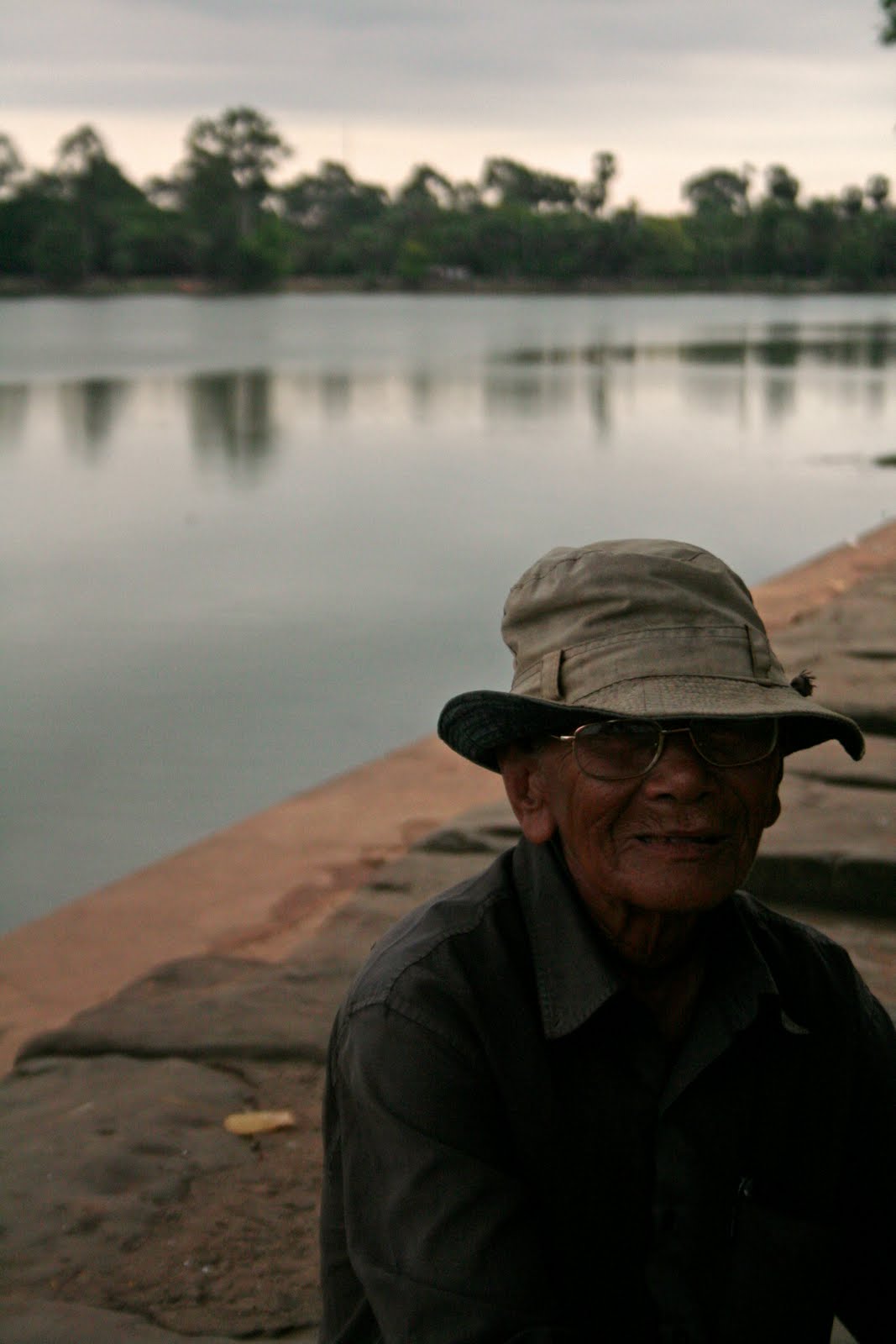
I sat for a while on a stone wall overlooking the structures across the moat taking photos. Aesthetically, if Angkor Wat has a theme it is contrast. Ancient stones sit atop deep green grass with patches of burnt dirt. All of this is reflected in the greenish waters of the moat.

I spoke for a time with a Khmer man. He asked if I spoke Khmer and I told him that I didn’t. He asked if I spoke French and for a time we spoke in broken French. The man was this warm, timid, meek character. He asked why I was here, where I had been, and then if I could give him any money. I gave him what I could, which was admittedly not very much, but he let me take his photo.

Across the moat is a photographer’s haven. The very stone these massive buildings were made from puts focus on their age. The darkness adds to shadow and gives everything this almost mystical quality. On the foot path, green grass pokes out.
There is a pond some ways into the complex. On one side is a kind of bazar populated by over-aggressive vendors vending overpriced merchandise. If you refuse to buy a painting they will try to sell you a Pepsi.

A canoe sat on the shore, tied to a kind of palm. About the pond nude children ran about as their parents begged the hundreds of visitors for change. A horse in elegant and festive dressings stood tied to a post. An Indian woman crossed in front of all of this and the crumbling buildings in the distance. She was dressed in a flowing gown of bright colors that contrasted with her skin, and for a minute I forgot what country I was supposed to be in.

Inside the main building are both empty, forsaken corridors that are empty and dark save echoes from afar and light from some stone cut window, and courtyards filled beyond capacity. Across, a group of children dressed in shiny soccer uniforms of every color of the rainbow pose for photos against the dark stone and shadows. The flow stops as people photograph them. The occasional lone child, dressed in red or blue darts around a corner or is stopped for a photograph. Then, a man asks for a donation for the orphans- smartest scam ever.

In the main courtyard, a line stretches almost full-circle around a great tower. Visitors climb to the top and then crawl down a set of metal and wooden stairs that make for better chances of survival than the crumbled steps beneath them; still, some are going down on their ass.

I do nothing but wander and sweat and click the shutter of my camera and dread the day I have to go through all of these images. I wander to every corner of the obvious compound and marvel at the age of the place. It is that nice sort of attraction that does its job by making you feel insignificant in the grand scheme of things. Every now and again obvious bullet holes dimple the stone, a product Cambodia’s past and present conflicts with Thailand.

The last photo I make is of a young monk in bright orange robes standing against stone carvings. I count my blessings and leave.

In the hotel I watch, of all things, the Red Sox because NESN is playing on Cambodian TV. I also become aware that I forgot to close my window and that there were now hundreds of bugs flying around.

The next day I went to Thailand.


**For more photos go here

Read more...

Security Prison 21, Phnom Penh, Cambodia

Saturday, June 25

S-21, Phnom Penh, Cambodia.
After the Killing Fields at Choeung Ek, DJ Camera drove me across the city to an extremely dense section of sprawl. Faded buildings stood looking at the remnants of a school. The school was fenced and largely walled off and topped with razor wire. Care had been taken to provide some division between the school and the houses behind. The compound consisted of five or so buildings that looked like a plain old school because it was once just that. At an opening in the wall, next to another ticket booth, milled the standard group of tuk-tuk drivers and amputees.


Again, I was not bothered. The sun was strong and the shade beneath the fruit trees, while not cool, was a little more bearable. At most, the beggars and drivers made half assed efforts to solicit, but it wasn’t anything more than shallow obligation.

Tuol Sleng Genocide Museum, formerly called Security Prison 21 (S-21), formerly called Chao Ponhea Yat High School. It marks the decent into madness, panic, hysteria and cruelty. Even in the middle of the day, walking the grounds and the halls of this place makes you feel uneasy; claustrophobia and panic aren’t ever far away.

The history of this place is everywhere. It was once a school. Fruit trees dot the grounds and if it weren’t for the obvious modifications that can turn a school into a place of hell, it simply looks like a school. There weren’t many people there so it was often hard to believe it was even a museum.

Inside a cell.
After the Khmer Rouge took over, the school was turned into a center for imprisonment, interrogation, extreme torture and murder. For a handful of years in the mid to late 1970’s, somewhere around 17,000 people, most innocent, came here to answer for their crimes against Pol Pot’s regime.

The place has this unchanged feeling that makes you uneasy. Rows of connected classrooms now host miniscule holding cells made of decaying brown wood, inches thick. In the middle of the floor there are rusted shackles and stains of a hasty paint job. The paint is red and in whatever light that comes through barred windows makes it look like blood.

To step into one of these cells and close the door is to feel that sense of hopelessness and doom. There is not enough room to move and there is no breeze; humid, oppressive air becomes stagnant and suffocating.

What’s more are little relics of S-21’s past life that weren’t removed seem to serve as a taunt to those who were imprisoned there. At the end of the hall an ancient chalk board still clung to the wall, its faded green contrasting with stone and reinforced wood and metal latches.

A classroom turned cell-block.
The open-air hallway of the second floor of the prison is sealed by a net of barbed wire. This “net” I was told was not so much to keep somebody from escaping, but to keep a person from being able to commit suicide by jumping from the railing.

The whole place was terrible. On the grounds were a handful of graves, whose occupants were so badly decayed and mutilated that their identity is unknown. They were the last to die S-21 before the Vietnamese overtook the Khmer Rouge.

The methods of torture in this place were creative as they were cruel. In an effort to extort a confession or get more names, guards would electrocute, suffocate, drown, half-hang, stab, beat, rape. If names were given, guards would repeat the process on people who probably had no idea what they had done. There are stories of victims who were tortured so badly that they confessed to outlandish things like joining the CIA at the age of 12.

A line of Cells.
Infront of one of the buildings is a set of uneven bars that adorn every playground. Guards punished their victims by tossing a rope over, tying their captives arms behind their back and hoisting them into the air.

Throughout the classrooms that weren’t full of prison cells or methods of torture, there were photographs of mutilated people, some alive and some dead, who had spent time at the prison. Their stories were painful to read as their spirits were as broken as their lives when they left that place, if they lived.

For a time in the beginning, prisoners were executed at the prison and buried nearby, but soon the sheer numbers made that impossible. After a time they were carted over to that other cheery place, Choeung Ek, the Killing Fields, where they were killed with whatever could be found.

After I left, I thanked a still hungover DJ Camera for bringing me to these places, had a drink in my room, woke up and got the hell out of Phnom Penh.


Read more...

The Killing Fields of Cambodia

Friday, June 24

The next morning when I met DJ Camera in the restaurant downstairs he was not so chipper. He greeted me with a genuine hotel, but his eyes were vacant and he looked uneasy. I thought for a moment and wondered if our destinations for the day had him uneasy and morose.


No.

It was the booze. DJ Camera was royally hungover. I wondered if maybe he was still drunk.

I was greeted by the manager, smiling just as much as the night before.

“Hello, Thomas!” He said. “DJ has lived through the night, I think.”

I ate a quick turkey sandwich and was soon in the back of a silent DJ Camera’s tuk-tuk, flying through the dust of Phnom Penh.

The Memorial Stupa contains thousands
of skulls.
We drove through the cluster of hotels and guest houses that populated the area next to the Chan Chhaya pavilion. I bounced in the back as DJ Camera picked up speed, mumbled something I didn’t catch, and launched us across a couple of lanes and into the frenetic every-way traffic fiasco that is every country in Asia.

Tuk-tuk is a good way to see a country. I used to think buses were the best means of efficient transport to see a country but tuk-tuks have this way of putting you directly into the action. For example, my eyes were constantly watering from the dust that was kicked up by the traffic. Also, as DJ Camera cut-off, squared-off, and otherwise basically played an extended game of Chicken with every driver in Phnom Penh, I felt a very real fear of death; something like a bus might have denied me this great cultural experience.

After a time the traffic thinned and the buildings on either side of the road descended in structural integrity until they were nothing more than shacks made of salvaged aluminum. The presence of shoes became rare.

We passed vehicles full to the tipping point with wood, goods, junk or people. Every so often we would pass green fields marked with giant puddles and the burnt-sienna mud and a cluster of water-buffalo. Kids walked and laughed in groups and bikes whizzed by leaving trails of dust and exhaust.

We crossed a river that was edged on both sides with houses on stilts, made largely of blue tarps and mismatched bits of wood, metal, and cloth. They stood on stilts and resembled tree-houses if you could put extreme poverty out of mind for a while.

--

Mass graves.
Choeung Ek. Outside the ticket booth a handful of amputees begged money or stood in the shade. It was extremely hot so mostly they just hung around in the shade.

At first glance, Choeung Ek doesn’t seem to earn its other names. It feels like you are buying entrance into an old orchard, or a second rate park. Off in the distance stands a Buddhist stupa that reaches to the sky. It looks as though it might be a kind of museum. Signs in Khmer and English dot the trails next to these pool-sized divots that cut into the earth. Grass has grown over these holes so their presence is muted, not shocking but unnatural.

The Killing Fields.

That so much of Cambodia’s tourism, particularly in or around Phnom Penh, is directly related to such a horrible time in the country’s history says something about their willingness to face such a nightmare without balking. The atmosphere at Choeung Ek, the best known of many Killing Fields is subdued, quiet, a bit creepy, and sad but it also has this feeling of “look at this, look at what has happened here, how?”

Victims of the Khmer Rouge.
I walked around Choeung Ek because that is really the only thing you can do there; it isn’t a place you really enjoy or are entertained. Groups of people were doing the same thing as I, some with guides who spoke in whispers.

The stupa was full of skulls. Thousands of skulls. They stare out of a central tower in the center of the structure and from the walls opposite. To walk in the narrow path around the stupa is to be flanked on either side by the faces of horrible deaths.

Estimates say that well over a million people were killed by the Khmer Rouge regime of Pol Pot. Many of those people died in places like this and were buried in mass graves in places like this. Many people died in this place.

The divots in the ground were mass graves. Gnarled trees reach from their sloping edges, their shapes perverted by the uneven ground. Next to the trees are displays of what happened here and what is still happening as a result of rain and earth’s tendency to regurgitate what is put into it.

Remains that came to the surface.
There used to be a chicken coup in my back yard. It was destroyed a long time ago, but still pieces of glass come up through the dirt when it rains. Here, in Choeung Ek, torn strips of faded clothing and bones are still coming to the surface and are laid to the side. The bones at this tree belonged to a child, says the sign.

I walked through the woods for a while. The entire park was silent. At the back side there was a pond and then a barbed wire fence marking the end of the property. Shoeless and shirtless boys begged with their hands reaching through the links. Later I listened as a guide told his charges that he lost his whole family to Pol Pot and the Khmer Rouge in these fields.

“Sad place,” said DJ Camera when I returned to his tuk-tuk. “Now, we go to school.”

Read more...

Phnom Penh, Cambodia: DJ Camera

Tuesday, June 21

DJ Camera, my tuk-tuk driver in Phnom Penh, Cambodia, was beginning to creep me out; not majorly, but I was beginning to dread his jolly, round face, and off-centered dirty baseball cap.


He was everywhere.

I arrived, admittedly thanks to DJ Camera, at the Noura Motel unscathed and found that while the $20 rooms were occupied, the manager was willing to let me stay in a $35 room for $25. DJ Camera had something to do with this and I was grateful, but he lingered about the tiny reception desk for too long.

“OK, Thomas,” he said in his over-excited manner of speaking, “go to your room, relax, come down. I wait for you and we make plans for tour tomorrow. We do many things.”

I looked at him and my heart sank a little. His sweaty brown face was staring at me and smiling. He was selling me something. Cabbies, whether in a car, on a bike, or pulling a rickshaw, in this part of the world are always trying to sell you something.

I handed him the few dollars that I owed him and told him that maybe I would see him later, and if I was to take a tour I would go through him.

DJ Camera shook his head in the negative and steamrolled my hesitation and told me that he would take me anywhere. I told him “maybe” a few more times

The Noura Motel has a layout and atmosphere that reminds one of an Old West saloon / hotel. Stairs lead to hallways that branch in many directions, looking over a small bar lit by dim, flickering bulbs. Idle workers stood talking by empty tables that spilled out towards the street. The street was teeming with beggars, tuk-tuks, and the fire of the setting sun.

I was shown to my room on the second floor. I walked through a reading room and down a hallway that led to a wide open balcony. Just across the street stands the royal Chan Chhaya pavilion, a part of the Royal Palace; its green lawns dotted with barefoot kids, sleeping tuk-tuk drivers, and a few soccer balls.

If I didn’t want to sit in the wicker chair and watch the setting sun, then I could have seen it from the massive windows in my room.


Sure enough, when I found my way to the main lobby to leave for dinner, DJ Camera was waiting for me. He sat at a small table just outside of the hotel. As soon as I was close he sprung up and asked where I was headed, if I wanted a ride, and began listing the things we could do the next day.

I cut him off. I told him that I appreciated his effort, but I wasn’t sure if I would be taking a tour tomorrow and that I might just wander around and take photos.

He looked hurt for a moment.

“OK, tomorrow when you want leave,” DJ said, “I will wait you outside hotel.”

He then grabbed my hand, shook it whilst ignoring the growing annoyance on my face, and sat down again.

I understood why DJ Camera was so eager to seal the deal: “maybe,” and “I’ll call you,” generally mean “no” and “fuck off” in his line of work. That has certainly been the underlying meaning when used by myself. What I could not understand was why he didn’t give up and look for business else where. And why was he still outside the motel!?

I walked towards the Meekong and sat down to a traditional Khmer meal of Italian grinder, fries, and alcohol.

I thought of my smiling DJ Camera and of a taxi driver in Mexico.

It was a few years back and I was wandering up the wrong road on the wrong hill. Drug cartels were beginning to take hold of the edge of town and apparently I was walking straight that way. A cabbie came running up, grabbed me and asked me as polite as possible as to where the fuck I was going and if I wanted to die?

I replied no, that I needed a cheap place to sleep.

He drove me for a while until we came to a hotel on the edge of a bay full of dirty water and men in tin boats hawking fresh fish.

This man had the same anxious tone as DJ Camera and wanted me to take a tour with him the next day as well but there seemed to be something more sinister about him. The hotel was on the edge of town and I became paranoid that this cabbie knew where I was and that my door was only a sliding plastic curtain. Friends from Mexico and guidebooks warn of local cabbies aiming for extortion, kidnapping, or worse.

I slept with my bed against the door and when he didn’t come to kill me and I never let him take me for a tour I felt guilt. I was ashamed of my paranoia.

Still, DJ Camera just wanted my money.

DJ Camera asked me how my dinner was when I arrived at the hotel. I shot him a look but there was no reaction..

“Tomorrow…” he went on again.

“MAYBE!” I told him and walked away.

“I will wait you tomorrow.”


After a few power-outages I headed downstairs to use the wi-fi and have a bottle of Angkor beer, the local version of the cheap, flavorless, working class beer of the world.

The two person bar staff talked in a corner and the tables outside the hotel were swarmed. Laughter rose frequently and the slamming of beer glasses and the clink of utensils against glass plates. Khmer filled the air. I half expected DJ Camera to —

“Hello!” said DJ Camera, standing up from his chair outside.

I stared at him in disbelief. Behind him tuk-tuk drivers slept in their vehicles. People walked by on their way to the bars or restaurants of the Phnom Penh night; but here was DJ Camera, still sitting outside my hotel.

I returned the greeting, disregarded whatever else he said and continued to drink my unfinished beer and then a second when I felt somebody staring at me.

I looked out the door and DJ Camera was stooping in, looking uncharacteristically meek. I stared at him for a moment and he spoke quietly.

“Thomas,” his memory was impressive, “please, it is a happy night. You are in Cambodia. Do not sit alone. Sit with me outside and drink.”


Shit.

I had him wrong like I probably had the cabbie in Mexico wrong. I pride myself in adaptability and openness in travel but here, I had it all wrong.

What the fuck?

I smiled, closed my computer and joined a smiling DJ Camera outside.

The table was full of food and pitchers of beer. There were two men at the table with DJ Camera. They smiled at me. A group of extremely beautiful girls laughed at me as I mumbled awkward “hellos“.

The man next to me was another tuk-tuk driver and the man next to DJ Camera was the manager of the lovely Noura Motel, and a close friend of DJ Camera’s.

“We are like family,” said the manager, a squat smiling man with one of the friendliest faces I have ever seen. “We take care of eachother.”

I felt shame.

I looked at the man who I assumed wanted only to take my money.

“Tonight, Thomas,” DJ Camera said, “you are our new friend and we take care of you.”


They did take care of me. There were pitchers of local beer mixed with a beer from Singapore. They pushed a kind of edible rice cloth my way and it tasted like a neutral rice cake on it’s own but it was heaven in the sweet, fishy dipping sauce.

“Traditional Cambodian,” my new friends told me.

There were questions about me, questions about my time in Korea and Vietnam. There were questions about Cambodia, whose answers were to be expected:

“Cambodia is the best!”

The four of us spoke and drank for a time as we descended into the universal language of drunkeness.

“Thomas,” DJ Camera said, eyes glazed over after declaring that he had left school sometime before high school, “you are my friend!”

“Good friends,” I corrected.

“I saw you alone and I take care of you. I take you to my friend’s motel. Tonight you eat and drink with us. We take care of you. Tomorrow I want you to see Cambodia!”

Finally, I agreed.

Jol Moi! We all said as we clinked our glasses and drank.

“Thomas,” said DJ Camera, “Can you understand my English?”

“Nobody can understand your English!” Piped in the other tuk-tuk.

“Thomas, DJ is very drunk. Nobody can understand!” Said the manager of the motel.

DJ began to introduce me to the girls scattered around in the night. The tuk-tuk drivers parked across the street looked over occasionally if they weren’t otherwise occupied by being passed out.

The night wore on for a while until finally the alcohol was gone. I pulled out my wallet but was hissed at by all three of my companions.

“Thomas,” said DJ Camera, “tomorrow I will wait you. Sleep long. I will be here.”

“Maybe you will have no tour tomorrow,” said the manager, “DJ will probably crash into a tree tonight!”

Read more...

Phnom Penh

Friday, June 17

Sorry all, I've been in Florida or otherwise occupied away from the computer.  Let's push and finish this ol' blog.  This next one might be familliar if you have seen our little magazine.  Anyway, after a long bus ride from Saigon, I ended up in Phnom Penh, Cambodia.


Cambodia, with its history of violence and a recent tragic past, is a place of dichotomy.  Common guides often speak of warmth, hospitality, and beauty on the same page as warnings of armed robbery and drive-by brick attacks aimed at foreigners along the banks of the Mekong on the same page.  The scars of the ultra-communist Khmer Rouge regime attract huge numbers of socially-aware tourists while leftover landmines and assault rifles have taken their toll on the population and given the country something of a renegade reputation.
Cambodia is a contradiction; at once beautiful and violent which gives way to the frequent comparison to the Wild West.  When driving through outpost towns on the side of a poorly maintained and heavily holed “highway” from the Thai border to the capital, Phnom Penh, this comparison is valid.
A burnt-brown dust hangs in the air, kicked up by every manner of vehicle from tour bus, to car, to homemade “Road Warrior” contraptions that would lead to instant arrest in the U.S.A.  Buildings stretch in rows alongside the road, both shaded by the tall palms in front and covered in their dead leaves.  The storefronts are well worn or run-down, depending on how you look at it.  Sun-worn locals adorn the entrances, sitting around, talking, drinking or smoking if they aren’t selling fruit, meat or sweeping away clouds of dust with palm-leaf brooms.  Many people kick up dirt to add to the ever present haze with bare feet.  Here and there men sleep in a ragged and faded hammock tied to a couple of leaning palms.  Dogs lay in the shade batting flies and the occasional weathered old man with patchy brown skin and unkempt hair wanders naked into the Mekong.
The guidebooks lead you to believe that some of the people in this “frontier” are armed with more than a six-shooter.  They are probably right but it doesn’t seem to matter much.
A store in Phnom Penh, Cambodia
I will confess a certain level of apprehension and paranoia before I crossed the border between Vietnam and Cambodia.  I have been in hairy situations before and Phnom Penh seemed to have potential for things to go bad pretty quick.
As the bus carrying a couple dozen travelers from Saigon to Phnom Penh -a mix of locals and western tourists- came into the city limits I began to wonder if I had bitten off more than I could chew.
There was no real plan, so to speak.  I had no place to stay and my wad of cash was becoming a little smaller each day.  Further, I had been hauling a year’s worth of possessions from South Korea along with my camera equipment; if there was a brick thrower in the area I probably wouldn’t even make it off of the bus.
When the bus pulled into a derelict station that consisted of a faded white stone building accented by decaying wood and a dirt “parking lot” I became overwhelmed.
I stepped into the oppressive heat and dirt-filled air to the barrage of tuk-tuk drivers shouting, beckoning, and stopping one step shy of kidnapping.  Luggage was pulled from the storage compartments of the bus and dumped onto the dirt.  It was hard to maneuver between the people and vehicles.  Tuk-Tuk drivers spoke in varying levels of English, and a blizzard of Khmer filled the air.  The crowd of my fellow bus travelers dissipated in a cloud of confused faces staring off, unable to efficiently process what was going on until one of the tuk-tuk drivers shouted loud enough to cut through the staccato and then they were riding off into a cloud of dust and a cluster-fuck traffic.
I picked up my dirt covered luggage and tried to leave the chaos, only to come face to face with one of the tuk-tuk drivers.
“Are you alone?”  He asked.
“Yeah, I am.”
“OK, then I will take you to a hotel.” He said.
“I need a cheap one.”
“Ok, $25,” off the top of his head.
I agreed.  I had been taken for a long and expensive ride when I was in Saigon to a hotel with an astronomical price.  Cheaper accommodation can be found in Phnom Penh, but I didn’t mind paying the $25 if I had a decent place to sleep and didn’t have to worry about being shot, stabbed, hit by a brick, or all three at once.
The driver, a squat dark skinned man in a baseball cap loaded my luggage onto the rack and I hopped into the back for my first tuk-tuk ride.
Tuk-tuks seem more exciting than they are because they remind you of a hay-ride or going down a hill in a red wagon when you were a kid.  Ideally, a tuk-tuk ride is less apt to send you flying into the certain death of Phnom Penh traffic but the possibility is there and that makes it exciting.  Also, like all of Southeast Asia, there is the chance of actually being a participant in a motorbike bag snatching which can result in such vacation-making events such as a stolen camera or death, if you are unlucky enough to be pulled onto the street.
I sat with my camera bag tangled in my arms.
My driver called himself DJ Camera.  He was a gregarious man somewhere near

middle age.  He spoke with the enthusiasm of someone trying to sell you something, anything.  He asked where I was coming from and what I was doing tomorrow.  The roof of the tuk-tuk was adorned with flyers of tourist attractions and DJ Camera arm-in-arm with blonde girls and backpackers.  DJ Camera was also a guide.
We passed the ever-present Southeast Asia gas stations: small wagons with cola and Fanta bottles full of gasoline and baking in the sun.  Motorbikes whined past us and people crossed the street, often barefoot, with no apparent regard for their lives.  An occasional “delivery” bike passed by, recently slaughtered poultry bouncing were strapped to the sides; they flopped with each bump as though reliving their death throes.
“Tomorrow,” DJ Camera said as he played a mad game of Frogger with his tuk-tuk and our lives, “I show you Cambodia.”

Read more...

Concerning Photographs

All images are my own unless otherwise noted. I am no Capa, but please respect that photography is how I make a living and ask before you use any images.

-Tom

Blog Archive

Just trying to stay relevant.

Footer

  © Blogger template Noblarum by Ourblogtemplates.com 2009

Back to TOP