Showing posts with label Traveling. Show all posts

Sunday, August 21


Jordi's Village, Spain
What can I say about my time in Spain?  For one thing, I was apparently so excited to get on out of Asia that I arrived a full 4 days before I had planned to.  It was luck that on the last bit of battery I got a hold of my friend and host, Jordi, and informed him that I was at the airport in Barcelona awaiting his arrival to pick me up.  I was tired and was basically out of money and stretched a bit too thin.

His reply was something about “what the fuck” and “are you kidding me” and that he was on his way.  For a little while I was worried about old Jordi popping me one in the face but he did not.  Instead he rushed over, swore at me, gave me a hug and took my things. 

Jordi is an old friend.  I knew him for a time when we were both waiters at a restaurant and were two of a very small group that actually gave a shit and worked.  He was an international student and spent his last week living at my apartment in Brighton before returning to his native Barcelona.  Now I was repaying the favor, or rather he was. 

Add caption
So, for a little less than a week I stayed with Jordi, his wonderful mom, and his incredibly obedient dog at their apartment in a village by the sea, less than an hour to downtown Barcelona.  It was relaxing and for the first time since I left Korea I didn’t have to think about anything other than what I would have for breakfast (usually cheese and sausage) or where I wanted Jordi to take me.

Barcelona
I met his friends on the first night at a dinner party that I couldn’t stay conscious at.  I took great pride in declaring that I was slightly tired because the last time I had slept I was in Thailand.  I ate pickled fish in olive oil.  I met Jordi’s family at a kind of giant dinner party.  For a while I think his family felt bad that I was sitting there unaware of what was happening due to my zero Spanish language skills but I tried my best to make them understand that at this point not understanding was my life. 

I drank wine and I ate.  For two or three days I was left alone as Jordi had to work and I wandered the village, sitting by the Mediterranean watching the waves crash while eating olives and cheese because I am a massive clichĂ©.  I discovered that clothing is not a legal requirement and that beaches in Spain are a magical thing to a guy who had just spent a year in East Asia. 

I took the train to Barcelona.  The rail ran along the beach and I made certain to get a seat at a window overlooking the coast and basically saw a million boobs.  I ate aged ham and wandered around the Placa Catalunya.  I drank coffee in a market and watched as gypsies begged along fountains lined with statues and pigeons.
France

Every night Jordi and I walked along the beach with his dog and then to the market to by cheese or else something for dinner.  I watched TV and read each night in the guestroom in which it was impossible to move because of my luggage.  I did laundry and took a long shower, the first since Cambodia. 

Andorra
We went to the South of France, to an old village in the mountains on the edge of an active military fort.  We saw a woman walking around with a grenade launcher like it was no big thing.  We ate Croque Monsieur sandwiches at a cafĂ© high in the mountains.  We drove through the small country of Andorra and I basically hyperventilated at every curve along the cliff’s edge.  I saw snow for the first time since winter. 

I met Jordi’s cousin, a local tennis star, and we saw Fast Five in Spanish.  Translation was unescessary as it appeared to be universally terrible. 

At the end of the week, Jordi drove me to the airport.  It was sad to say “goodbye” to him, but it was sadder to know that it was actually all over. 

A few hours later I was in Dublin.  A day later I was watching the doors past customs open at Logan Airport.


Read more...

Border Crossings and Riding in Cars with Russians

Tuesday, July 12

Pattaya, Thailand
Sometimes when you are on the road, traveling for a long time you hit a wall.

I hit the wall in Thailand.

A tuk-tuk brought me to a back-packer guesthouse in Siem Riep, Cambodia. It was early enough for me to be barely awake and also miserable, but it was already hot and humid enough for me to be drenched in sweat.

Further, the place was jammed and there was really no room for myself or my two rolling-luggages, backpack, or camera bag and I basically just stood red and wet in the middle of everything like I was totally fine.

At some point a big old bus came rolling up and we were carted on. A girl around my age, who happened to be quite large, sat in front of me until the driver made a big fuss about her size and made her sit on the tiny, fold-out seat at the front to the bus.

The bus went to the Thai border. Here we were let out at the most grueling border crossing I have experienced thus far in my life.

To begin with, the bus dropped us off in a cluster-fuck of traffic. All around were trucks, freights, cars, motorcycles laden with all manner of luggage and goods. Once past all of that, we had to stand in line at a check point. While waiting and sweating profusely, I exchanged a few hundred US dollars and the bulk of my remaining Korean Won into Thai Baht. It was sad to part with the won.

Once through the checkpoint, I had to drag my luggage somewhere close to half a mile, over curbs, broken sidewalks, through groups of people and chickens (seriously) to the other side. It was a sort of no-mans-land, I guess. Here, I waited in line again, this time with sweat pouring into my eyes as I passed into Thailand.

Once my passport was stamped I was pointed through some doors, hollered at to walk straight and take a left, hollered at again that I went the wrong way, and hollered at again to find the right bus. The bus company tasked with getting me from Cambodia to my randomly chosen destination of Pattaya, Thailand, apparently ran several routes.

So, I sat or stood and perspirated for a time underneath the awning of a little market. Some people tried to eat ice cream before it fell onto their shirt. A guy with long hair was talking about doing a work camp, I thought about chiming in about my camps but remembered that it was too hot and I wasn’t in the mood to talk to anybody.

We waited an hour or so. Vans came, picked up the right people, and were then bouncing on the dirt road to such places as Bangkok or Phuket. I fell into conversation with the large girl from the first bus. For the sake of not calling her “the large girl” I will call her Mary, for no reason. I do not remember her real name.

She told me that she was returning to Pattaya from vacation, that she was staying there for a couple of months trying to soak up the experience, and that I should shadow her until we arrived. So I did.

When our van finally arrived the driver and his little buddy were dismayed when they saw my rolling luggage. They argued amongst themselves and then started shouting my way.

“This is too much!”

I stared at them and said something like “uhh ok.” I was wondering what the hell they expected me to do about it, and besides nobody ever mentioned an official baggage limit of the “White Rape Van Travel Bus Company” when they told me I must pay.

Here we go again, I thought.

He then quoted me 90 baht, around $3. Mary said he was ripping me off but after getting taken for a $50 cab ride in Vietnam (twice) “ripping off” can become a relative term. So, we loaded into the van, a fuss was made of the size of Mary, and we were off.

In the van was a Russian couple, Mary, and myself. Mary made a comment about how nice it was that the van wasn’t crowded, then immediately after karma punished us all for something.

We spoke for a while, not really noticing that the van would occasionally stop at a corner or a checkpoint and somebody new would hop in. Mary was essentially on vacation. She had a friend who owned property in Pattaya and had set her up with a place to stay for a few months. As for what she did in real life, I don’t know. She said she was going to try and rotate between life in small town USA and Pattaya.

The Russians were on holiday for a few months and were, like me, almost at the end of the road: they had a handful of days in Pattaya and then were heading back. Somebody made a crack about the American having a lot of baggage for a vacation and I felt it necessary to inform them that I had been living in Korea for a year and had been unable to send as much home via cargo ship as I had hoped. I felt vindicated.

The bus could seat 11 comfortably. By the time we passed through the last armed checkpoint near the border, there were 15 people jammed in on top of the luggage. I was cut off from conversation and basically jammed into the window. The air conditioner basically became pointless.

It took us a long time to get where we were going and while the tropical trees and landscapes of Thailand were nice to watch, the general crappiness of the van became too much to handle.

After a few hours we were let out at a gas station where I met a ladyboy and ate a kind of cheese pastry and bought a water. Then, the Russians, Mary, and I waited with anxiety for the van to come and pick us up and worried if maybe it had left us.

It didn’t, and hours later we finally arrived in Pattaya.

The sun was sinking and that nervous feeling I get when I get to a place with no plan whatsoever was put to ease by Mary offering to get the Russians and myself to the main drag so as to find cheap lodgings.

My baggage became an issue again. In Korea there are taxis, Vietnam: taxis, Cambodia: tuk-tuks; in Thailand there are dudes driving pickups with a couple of benches in the bed. They wanted to charge us extra and Mary did not want any of that nonsense.

I did, but I was tired and hungry enough to where I was starting to lose grip on what was really going on. So, Mary called up her friend and soon I found myself flying through town in the back of a pickup with a couple of Russians sitting on cardboard boxes.

Read more...

Angor Wat, Cambodia

Thursday, July 7


DJ Camera and the manager of the Noura Motel were kind enough to set me up with transport to and lodging at Siem Riep, a few hours north of Phnom Penh, Cambodia. So, early the next morning I was picked up in an overcrowded van and made my way to one of the most beautiful places I had ever been to.


The way to Siem Riep is gorgeous and at times difficult. There are valleys of deep green with scattered bodies of water that are no deeper than a glorified puddle. Water buffalo and other manner of livestock graze, drink, or block the road. Then there is the ever present presence of extreme poverty; worn bare feet walking in the dust on the side of the road, shanty towns made largely of tin and blue tarps. Emaciated dogs darted into the road every so often.

Still, I was thankful that the trip did not take so many hours as the bus trips I had made in recent weeks as I had been jammed into seat that would not have enough leg room for a small child and the air vent was apparently just for show.

The van arrived at a dirty but quiet bus station in Siem Riep sometime around noon. The town seemed a good deal smaller than Phnom Penh, but still it was overwhelming to be hit by the barrage of hawkers and tuk-tuk drivers.

This time, it had all been planned in advance. A squat man, similar in features to DJ Camera but a good deal younger and less enthusiastic, approached me from the shade of his cart.

“Thomas?” He asked.

“Yes.”

“Ok, I take you to the hotel.”

We drove through the streets and it became apparent that I was a long way from Phnom Penh economically, if not distance-wise. It looked -how do I say this without coming of as insulting or belittling- bland. To be honest, I appreciated bland. The level of poverty was nowhere near as apparent. The landscape was not as impressive and rough as Phnom Penh, but it maintained the sort of charm that comes with a small town in New Hampshire, or Vermont. It had that feel that true, it wasn’t polished, but nor was it rough by any means. It was worn but comfortable.

The hotel I stayed at was the nicest place I stayed throughout the entire trip in that it was a characterless, uniform hotel that I have stayed in dozens of times before. There was no dirt, no grime, no prostitutes and no beggars meandering around. There was a little restaurant that served mediocre food, a small in-ground pool that I meant to use but never got around to it, and an actual reception desk. My room was large and unassuming. Further, the manager at Noura had gotten me a good deal and I was paying only $25.

Truth is I didn’t know very much about Angkor Wat. It was not the purpose of my going to Siem Riep. I went to Siem Riep because a lady in Vietnam told me that I didn’t want to spend too much time in Phnom Penh and that I might become bored or dead. So, when DJ Camera suggested it and mentioned Angkor Wat, I figured I should go.

Sometimes in travel, everything just works out.

My tuk-tuk driver drove me a handful of kilometers outside of the city. We passed what seemed to be a university and came to forested land. At a kind of toll booth I spent a good $30 on an entrance ticket to Angkor Wat. We then followed the narrow roads that wound around the edge of a forest. It was here, at the edge of the jungle that I saw what might rank as one of the highlights of the entire trip: wild monkeys!!

I saw wild monkeys!

I almost flipped the tuk-tuk whipping around to see them sitting there. I was hoping they might do something funny like steal somebody’s glasses, hell, I would probably laugh if they stole my camera, but they just sat there eating. Still, totally awesome.

The complex of Angkor Wat is massive. It sits behind a moat and is surrounded by jungle. Outside are throngs of people: vendors, beggars, scammers, tourists. My driver parked his tuk-tuk amongst hundreds of others, warned me not to buy anything and soon I was off.

I didn’t know much about Angkor Wat and still, this remains the same. I could include some facts here but that would all come from Wikipedia, and what is the sense in that? The important things:

-It is the largest religious building in the world.

-Its grounds are expansive.

-It is still a place held sacred by monks who make regular pilgrimage.

This is what I saw:

I sat for a while on a stone wall overlooking the structures across the moat taking photos. Aesthetically, if Angkor Wat has a theme it is contrast. Ancient stones sit atop deep green grass with patches of burnt dirt. All of this is reflected in the greenish waters of the moat.

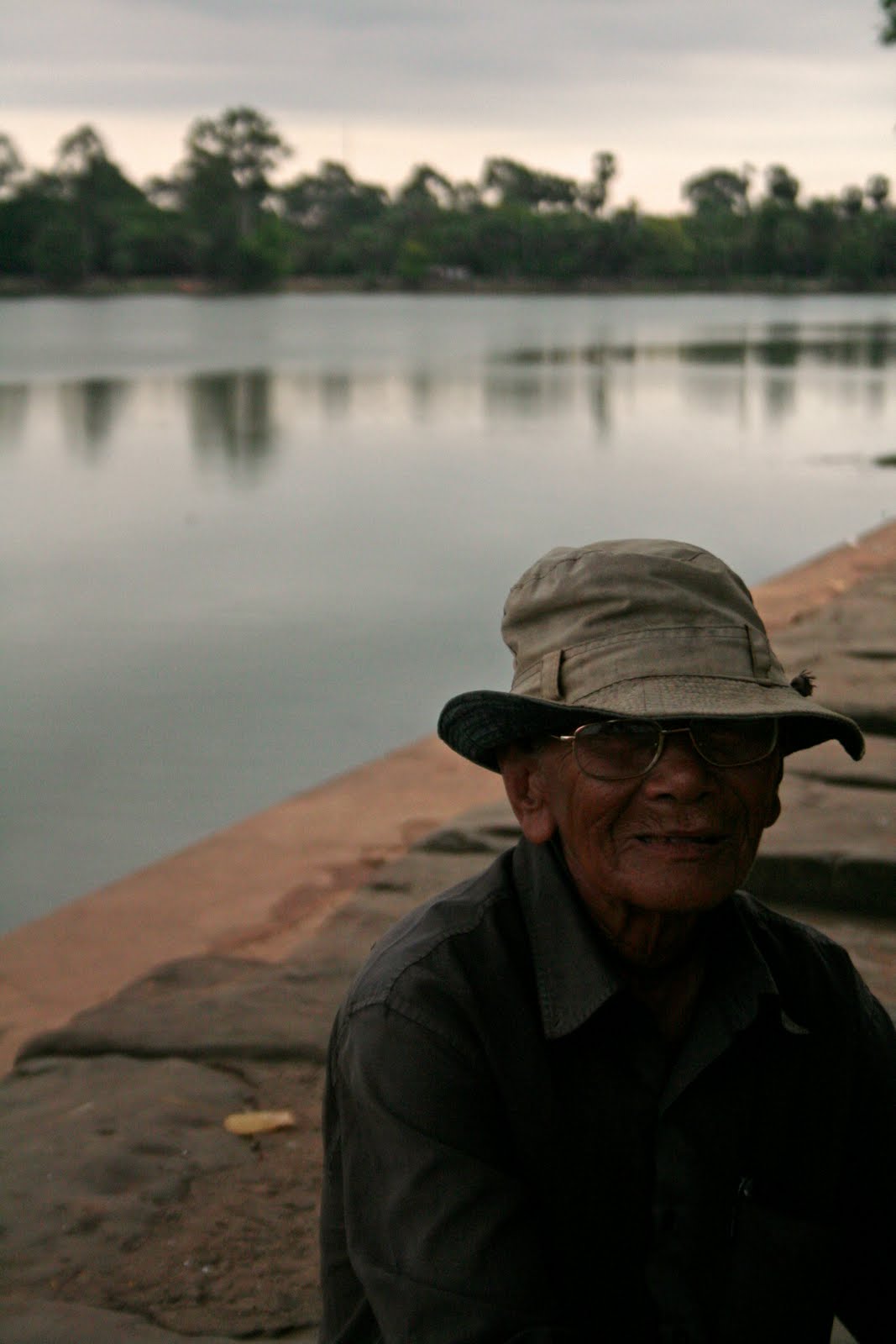
I spoke for a time with a Khmer man. He asked if I spoke Khmer and I told him that I didn’t. He asked if I spoke French and for a time we spoke in broken French. The man was this warm, timid, meek character. He asked why I was here, where I had been, and then if I could give him any money. I gave him what I could, which was admittedly not very much, but he let me take his photo.

Across the moat is a photographer’s haven. The very stone these massive buildings were made from puts focus on their age. The darkness adds to shadow and gives everything this almost mystical quality. On the foot path, green grass pokes out.
There is a pond some ways into the complex. On one side is a kind of bazar populated by over-aggressive vendors vending overpriced merchandise. If you refuse to buy a painting they will try to sell you a Pepsi.

A canoe sat on the shore, tied to a kind of palm. About the pond nude children ran about as their parents begged the hundreds of visitors for change. A horse in elegant and festive dressings stood tied to a post. An Indian woman crossed in front of all of this and the crumbling buildings in the distance. She was dressed in a flowing gown of bright colors that contrasted with her skin, and for a minute I forgot what country I was supposed to be in.

Inside the main building are both empty, forsaken corridors that are empty and dark save echoes from afar and light from some stone cut window, and courtyards filled beyond capacity. Across, a group of children dressed in shiny soccer uniforms of every color of the rainbow pose for photos against the dark stone and shadows. The flow stops as people photograph them. The occasional lone child, dressed in red or blue darts around a corner or is stopped for a photograph. Then, a man asks for a donation for the orphans- smartest scam ever.

In the main courtyard, a line stretches almost full-circle around a great tower. Visitors climb to the top and then crawl down a set of metal and wooden stairs that make for better chances of survival than the crumbled steps beneath them; still, some are going down on their ass.

I do nothing but wander and sweat and click the shutter of my camera and dread the day I have to go through all of these images. I wander to every corner of the obvious compound and marvel at the age of the place. It is that nice sort of attraction that does its job by making you feel insignificant in the grand scheme of things. Every now and again obvious bullet holes dimple the stone, a product Cambodia’s past and present conflicts with Thailand.

The last photo I make is of a young monk in bright orange robes standing against stone carvings. I count my blessings and leave.

In the hotel I watch, of all things, the Red Sox because NESN is playing on Cambodian TV. I also become aware that I forgot to close my window and that there were now hundreds of bugs flying around.

The next day I went to Thailand.


**For more photos go here

Read more...

Saigon Traffic

Tuesday, May 24


The rotary. Saigon, Vietnam.

Saigon is set up in districts. District 1 is the main drag of the city and where the bulk of accommodations for visitors are located. The place is full of stores, sites, and people of every level of poverty and affluence. It was a dynamic and mad place and I am happy to have spent my time in Vietnam there.


Saigon, regardless of district, is controlled chaos, organized entropy. The mindset of Saigon is realized through the total shit show that is rush hour traffic. In District 1 there is a major rotary. In the center is a sculpture of a man who I assume is probably Ho Chi Minh. Five or six different roads pool into this rotary so that it looks like a nightmare to negotiate under normal circumstances.


In Saigon, like the rest of the world, rush hour is the plague of the day. The thing is rush hour seems to last most of the day here. Also, there are not too many cars. If there is some hidden population of four-wheeled transport then they know well enough to avoid this rotary.

Ajummas: not caring who is behind them internationally.
Saigon, Vietnam.
Instead of cars there are scooters and motorbikes. Thousands of them. When the traffic is bad, which is always, scooters clog the roads like blood pumping through excited veins. They ride as many abreast as possible and sometimes more than the road can hold. In effect, the street becomes a river raging in a flood, spilling rapids over its banks.

I made several trips to this artery. Firstly, because the spectacle of this traffic and the ragtag businesses that spring up about it (air-compressors, petrol in liter bottles of cola) is fascinating. Further, on the other side of the street is the backpacker district, full of cheap lodging, laundry, food and other logistic vendors. It is the place to be.

To get to the other side of the road, especially at the peak, is a lethal Why-did-the-chicken-cross-the-road joke. It seems impossible. There are not many pedestrian crossing signals and if there are they are usually inoperable or universally ignored by drivers and pedestrians alike.

To cross the street is a test of faith and steadfast nerves. The trick is this. Find an opening and start walking. Do NOT change your speed. It might even be helpful to look forward and pretend that there are not 800 scooters whizzing by you. Reach the other side and thank god that you made it. The other option is to wait for a local to cross and hope that they soften the blow when that hit comes.

Scooters.  Saigon, Vietnam.
There is a constant peal of anxious horns. Drivers on these roads seem to beep not so much as a warning or threat so much as an acknowledgement that they are entering into your space. Given that the roads are total gridlock (very fast moving gridlock to be true) the sound of whiny horns is constant.

Every so often a man in a pedal operated tuk-tuk or a salvager pulling a car stacked impossibly high with junk will come on and mess everyone up.


Read more...

Seoraksan, Part 2

Monday, February 28

Forgive the belated posting here, I have been lacking internet for the past couple of weeks.  Anyway, I went to Seoraksan for Lunar New Year.

Seoraksan did not end up being the relaxing getaway that I was hoping for. Looking back on the whole trip, we spent way too much of our vacation on the road (even if the bus was barely moving). No, relaxing it was not.


An incense shrine against the mountains.

In darkness we stood at a bus stop in Sokcho, not entirely confident that we were in the right place. It was our hope to hop on a city bus that would take us to Seorak-dong. Here we would find a hotel with a Jacuzzi or at least a giant TV. The man looking like he was ready to scale Everest at the bus stop was reassuring.

Our back up plan, should the bus not come, was to take a cab. This would have been a costly mistake. After the bus finally came, we spent close to 45 minutes driving at first along the shore and then up the gradual incline at the base of Seoraksan National Park. For a long time we drove in total darkness save a few convenience stores lit by dim night-lights.

That taxi ride would have been costly.

Someday, I will stop assuming that when guide books mention a Noraebang, it doesn’t necessarily mean that a place will be hopping with neon.

Sarcasm and feigned bitterness aside, what would it be saying if this great mountain park had been so developed that love motels sprouted from its trees.

The problem is that I have become spoiled when it comes to hotels. Even at home, I always loved hotels. I don’t really know why. I used to have life-goal in which I could live in a hotel permanently. I realize now that this is called homelessness. Still, coming to Korea and being able to afford rooms with hot tubs, giant televisions, and steam showers has set me up for disappointment.

Sorak Garden Resortel. What I remember is that it had a large lobby with a guy watching television. It was night and he welcomed us in and quickly arranged rooms for us.

If you are a solo traveler I would back away from this place. It wasn’t sketchy and the man at the counter was really friendly it just had a run-down feel that bummed me out.

It wasn’t that it lacked a bathtub (it did, it also lacked any hot water), or a fully functioning TV (only a handful of channels worked so I watched short track and ski jumping) it was that it was like a bigger version of my apartment but with no warmth or character. I refer to warmth in both atmosphere and temperature.

The “concierge” told me that our rooms had once been two singles, but each had a wall knocked out to make two rooms: a bedroom, a larger open space for yo’s (sleeping mats) a “bathroom” and whatnot.

If I went with a whole bunch of friends and we stayed in one room it probably would have been a cool room. Heck, there was even a little kitchen area. In any case, the place wouldn’t have seen so bleak and lonely to me. So, I watched TV with my four imaginary friends and ended up having to use a floor mat as a blanket because of the cold.

Seoraksan National Park was definitely worth the trip. We went in with the assumption that we probably wouldn’t walk all the way to the summit and therefore were not disappointed when that didn’t happen. After paying our entrance fee and storing our bags we set off on a trail that would eventually come to a couple of waterfalls (Yukdamp Pokpo and Biryong Pokpo).

We passed the main entrance, turned to our left, and then crossed a bridge over a largely emptied river. Already the views of the surrounding peaks were extraordinary. They might not be the tallest mountains around, but their granite peaks ripping upwards from the trees here and there give it all a dramatic feel. It all felt rough and natural. I appreciated the difference in feelings between Cheongju and Seoraksan.

The trail we followed was not very long (a bit over 2km I think) and wasn’t generally very difficult. There were a few parts that were a bit steep but any argument for it being a difficult hike could be negated by the fact that the trail did in fact have metal stairs.

The rusted and grated stairs would stretch across the river whose source was the waterfall and our destination, and would hug where the rock had been cut away by erosion. This river probably flowed powerfully in the rainy season, but on that weekend it was largely subdued by ice.

Early on, we passed a kind of concession area. I would call it a concession stand but it was a bit more than that, while definitely not being one of the folk villages that are common on Korea’s mountains. Here snacks were sold.

We passed a woman giving samples of homemade berry juice. Presumably she had made it herself from mountain berries and then bottled it (old soju bottle) to be sold for around 10,000W. She gave us a sample, proudly saying “no alcohol.” It tasted good and was refreshing in a sharp but sweet sort of way. It was also very clearly booze. It tasted exactly like blackberry brandy.

I would buy a bottle on our way back and give it to Han as a thank you for saving my camera. She told me later that even her dad was surprised at the amount of alcohol contained in non-alcoholic mountain juice.

We came at last to the waterfalls. They were frozen: cascading ice into a ripples pond covered in crusted snow. It was pretty. A few people sat around as we snapped some photos. A man meditated off towards the edge of the little pond. After a break we turned and headed back.

After learning that the cable car was out the question (the day was wearing on and the light was soon to be fading) we walked along a more well traveled path. I didn’t even feign disappointment over the cable car. It rose steeply straight into the highest crags of the mountain. The only scenery I would have seen from the ride would have been what my camera shot as I sat in the corner with my head down.

This path led to a clearing in which sat an enormous bronze Buddha. I knew none of this at the time but that likeness is significant enough to have made me feel humble for being in its presence even after the fact. It also made me feel a bit like a fool for not even knowing it was there in the first place.

For a good amount of time we watched as people lit incense, prayed, meditated, and generally showed a huge amount of respect for this huge sculpture. I walked back and forth, switching frequently between my normal lens and my zoom. The weather was becoming chilly and the fresh air was occasionally overpowered by incense.

I found out later that inside this statue are three pieces of the Buddha’s sari. The statue, like the red and blue bridges all around, represent the desire for a unified country.

Further along the path is a colorful temple with scalloped tiles. Two elaborately colored temple guardians stand in the dark on either side of the entrance. The temple, a compound of buildings, stands on a hill and is on the edge of a river. It is serene. It is Sinheungsa and it dates back to either 653 or 657 AD. It has been destroyed and rebuilt a number of times but it is still there.

Sometimes being in an ancient place is pretty incredible.

As darkness fell we made our way back to another hotel, further down in Sokcho.

The next morning I walked onto a jetty while I waited for Ricky and Lauren. I have never been to the beach in the middle of winter. I expected it to be bleak and desolate but it wasn’t. Kids played in the sand feet away from snow. Families walked along the paths and bought food from vendors as though they didn’t notice the chill in the air. I sat for a while photographing the waves as they crashed onto rocks or sand.

Further down, the beach is lined with barbed wire and guard towers poke out of the trees. Tank traps dot the highways if you go too much further to the north.

I then spent hours stuck in Seoul traffic trying to get back to Cheongju.


Read more...

Seoraksan Part 1: In which our hero tavels for a long time and loses his most valued posession

Tuesday, February 15

If I have learned anything about internal travel in Korea it is this: the news isn’t usually wrong when it predicts horrendous traffic.
After the eternity that was the duration of winter intensives finally ended, Korea was given a much needed vacation.  This was good news.  The overloaded class schedule and bouncing from school to school on Fridays without breaks had wrecked me.  I was looking forward to catching up on some sleep.
The plan, for myself and a couple of friends (Rick and Lauren) was to get from our respective homes in central Korea to the northeast.  We were making for Seoraksan National Park in Gangwon Province. 
One of the things that I will miss about Korea is that you are never very far from a mountain to hike on.  Even if it is not a very large mountain, there is usually some payoff.  Sure, Watchusett Mountain might offer some nice glimpses of Fitchburg and exotic New Hampshire, but the local hike here has a fortress that predates colonial America by a long ways. 
Seoraksan, it should be stated, is not a “local hike.”  It is almost as far from our cities as you can get.  What complicated this issue further was that we were attempting to get there on arguably the biggest travel weekend of the Korean Year.  Lunar New Year was the occasion of our vacation and it was the reason why everyone with a car in Korea takes to the road to reach their home villages and families that they left behind in on their way to urban modernity.  The result is that highways around major cities become something of a nightmare. 
The only other time of year that can compete with Lunar New Year is Chuseok.  We traveled during Chuseok too, but we had the benefit of a KTX (bullet train) that took us from Daejeon to our final destination for Gyeongju.  The KTX was a benefit we would not be enjoying for our relaxing Seoraksan vacation. 
Relaxing would also not be one of our enjoyments.
We would cross the peninsula via bus.  When I asked my coworkers how I might get from Cheongju or Daejeon to Seoraksan, Han informed me that we would have to switch busses a handful of times.  Further, she said that not only would we have to deal with the nightmare traffic, but we would also have to transfer bus stations at one point. 
This last part was what worried me the most.  Reading Korean is no problem.  Bus stations usually have destinations written in English.  What could be a problem was getting from one station to another in time to catch another bus.  Frankly, I was starting to recall the trip to Dacheon Beach in the summer.  I was wondering which one of us would be barfed on.
Han tried her best to simplify things.  Ara, the new teacher, did as well:
“I think you should just stay home.  Or you can just go to Songmisan (the local national park).”
This was actually a valid idea.  I wanted and still want to go to Songmisan.  I even meant to do so last weekend but I was sidetracked by eating lunch.
The thing is, when it comes to vacations I am stubborn.  I rarely budge from my initial plan and it is difficult for me to accept any compromises.  I don’t mean to say that I do not go with the flow and enjoy the unexpected- I am fine while I am ON vacation.  What I mean is that once I decided that I was going to Seoraksan, there was no way in hell that I wasn’t going to go to Seoraksan.  The complicated bus route and the potential 10 hour bus ride (it was ordinarily 4 or so hours) didn’t have the slightest impact.  In the end I conceded a day and we left on Thursday instead of Wednesday to avoid the bulk of the traffic.
The plan:
1. Head to Daejeon Wednesday and stay in my first of 3 motels. 
2. From Daejeon take 3.5 hour bus to Gangneum in the northeast.
3. Go from the intercity bus terminal to the express bus terminal (it could have been the other way around)
4. Take a bus from Gangneum to Sokcho, a bit to the southwest.  Once here, I was ready to call it a success.
5. Take a city bus to Seorak-dong, and find a motel in the national park. 

The reality was not much different from the plan save travel times.  I made it to Daejeon with no problems (like I’ve done many times before).  I stayed at the Sharp Motel near the bus terminal and, as always, it was awesome.  Rick and Lauren treated me to a dinner at TGIF so the day was a total success. 
The next day we woke up bright and early and met at the bus terminal (bright and early for hag won teachers is different from that of normal people: 9am).
The bus, according to the website left at 9:45am.  We then spent a couple of hours waiting around and drinking coffee counting down until 11:30ish when the bus actually left.
One of the benefits of being in Korea alone, is that more often than not nobody wants to sit with you on the bus.  On the rare instance when I am not put in a row with just one seat, the person assigned to sit next to me usually gets up and leaves once the bus starts rolling.  Maybe I should be insulted.  Maybe I should just stop showering at home so I can always sit alone on the bus.
So, for the entire 5 or so hours of the 3.5 hour bus ride, I stared out the window and spoke only to Ricky or Lauren when the guy on the bus TV did something weird.
Rick and I searched for food when the bus made a quick rest stop.  After getting on 3 busses because we failed to remember where our bus was parked we sat down and enjoyed our lunch.
It was called a kebab.  It was a skinny hotdog with spicy sauce wrapped in a soggy tortilla.  How I made it the rest of the way without crapping my pants, I do not know.
After a very long time the plains gave away to outcroppings of the Taebaek mountain range.  We came at last to a city bus terminal where we sat until the bus driver politely informed us to get off as we were at our destination.  It was here that I did the dumbest thing I have ever done.
I rushed out of the bus and stood on the sidewalk for a moment after the bus drove away.  I then realized that I had left a bag containing close to $2,000 worth of camera / lenses on the bus.  I sprinted after it but it was gone.
My joy for vacation was wracked with devastation.  If I wasn’t in shock I probably would have cried.  Not only was that camera important to me, but it was how I made the bulk of my income at home.  For a time I told myself that it was ok, I had to upgrade anyway, but it was all a lie. 
I would be the only moron on top of the mountain looking through the viewfinder and winding the film of a disposable film camera.
In a panic I called Han.  I felt bad for bothering her during the holiday but I saw not other option.  She was my Obi-Wan. 
For an hour things looked bleak.  Things looked real bleak.  She managed to get a hold of the bus company and eventually the driver.  She relayed the message to him that the camera had been left on the back of the bus.  He replied that there was nothing.  He would check the CCTV but he wasn’t hopeful.
“I am sorry Tom,” Han said.  I hung up the phone and felt ill. 
I was drinking coffee with Rick and Lauren in despair when Han called to tell me that they had found my camera, and if I could wait until 6pm, then I could pick it up at the company office upstairs.
Words can’t really describe my relief.  Oh, wait, yes they can: imagine losing your really expensive still camera / cheaper video camera / lens / etc. for an hour and then having them returned.  That is what it felt like.
So, camera bag firmly in hand, we embarked on the second to last bus of the night: Sokcho.  Luck was with us in that too, as we did not have to go to another bus station to get to Sokcho, as I had feared.
The way to Sokcho is interesting.  For one thing, the coastal road forces you to remember the conflict with North Korea.  Vast expanses of the shore are lined with barbed wire.  Here and there, there were manned guard towers casting halogen into the black sea under the moonlight.  According to the guidebook, there were several tank traps along this route to protect against invasion.
So, 10 hours or so after we left Daejeon, we stepped off the bus into the night of Sokcho at the base of Seoraksan.  There, we breathed in clean air for the first time in a long time.

Read more...

Chuseok

Monday, September 27

Chuseok. To the best of my knowledge it is a kind of Korean Thanksgiving. I tried to ask my students what Chuseok really was and what they would be doing but I didn’t get too much out of them. I should start wikipedia-ing this stuff. Perhaps this blog could be more than ramblings, violations of student-teacher confidentiality rules, and uninformed (and largely in factual) observations. But, I didn’t.

The Senecal apartment too early in the
morning
The vast majority of my students, when asked what they would be doing answered one of all of the following:

I will play with my cousins.

I will go to the hometown of my father.

I will eat songpyeon (a kind of rice-cake with sweetish fillings; which I incorrectly imagine as a weird jelly munchkin).

My coworkers tell me that it’s a harvest festival that occurs according to the lunar calendar. Surely, it has some decent history of traditions and customs but the important thing is that it is a time for family: both living and dead. Families make the trip home during Chuseok if at no other time if the year. Kids play with cousins they might not see regularly and adults catch up. Gestures are made towards those who have already passed. Tombs are cleaned and honored and food is left in remembrance.

Another Chuseok tradition is that Korea basically shuts down for a couple of days to the dismay of waygooks trying to take advantage of a significant time off from work.

Want to hear about a trip to what might be the most boring place in Korea and a night in what might be the creepiest motel I have ever stayed in? Keep reading.

In my defense, when I started planning a trip to Gyeongju nobody told me just how “quiet” Korea became. Sure, Han might have mentioned that some places might not be open and that travel via road might become tiresome (Seoul, a 2 hour trip in ordinary circumstances, can take somewhere between 15 - 20 hours). So, I assumed that maybe we would not be able to be so picky when it came time for bbq. Fine. It took some work but I booked train tickets from Daejeon to Gyeongju. There were three of us. Two of my best friends from the ‘bury are now teaching in Daejeon which is a short 50 minute bus ride away. Given that they have really just arrived and I never got around to getting them a wedding present and it was recently their first anniversary (god, one year ago I was trying to function at a wedding after working until 2am for the magazine and then being unable to sleep) I would drag them along. We would have a scenic train ride across the peninsula, see the sights, eat some food, watch TV, and have a grand ole time.

I should have just bought them a plate.
Rick and Lauren in front of a fake
burial mound.

We were out in the deserted streets of Daejeon before 7am. The place was a ghost town, and what’s more it was a dreary ghost town given that the weather had turned gray. Ordinarily at that hour there would be at least a few Koreans stumbling home from the bar but presently we had the city to ourselves.

A quick taxi took us to Daejeon Station where I picked up our tickets. The next day we would return via a train to Daegu and another to Daejeon. Poor Rick wasn’t given Friday off. As for myself, I would continue on to Daegu and spend a couple of nights there doing absolutely nothing productive.

The train to Gyeongju was just short of torture. It lasted somewhere close to three hours and while it went through some very beautiful terrain I was dead tired. Still, my inability to sleep in a vehicle and the occasional peel of thunder that comes as a KTX train passes by at 200mph kept my semi-coherent mind outside the window.

Sometimes life will have me believe that I am still at home. After 5 months I am well into the routine of wake up, go to work, go home, sleep, repeat. What was once exotic about Cheongju is not so any longer. The scenery outside of the cities reminds me that I am somewhere else.

Daejeon fell behind us as we traveled south. Cities became suburbs and those gave way to outpost towns. Then there was nothing but the mountains, rivers and rice patties. Grey weather gives way to deeper greens and high contrast. The mountains are always in the distance and about them clung a mist that stayed for the holiday.

If ever there was a time that Korea earned its name of “the land of the morning calm” it was then.

After a long time we were standing in the rain outside of a train station in Gyeongju.

Soon after we were in a cab as he took us to Bomun Lake Resort in search of a motel in the dreary mist. I was beginning to wonder about the damage to my bank account with a word like “resort,” but Korea proved me wrong.

Motel Sinla. The first warning should have been that the “l” and “a” were blacked out on the sign. Motel Sin. If you go to an abandoned Gyeongju on a grey and rainy day do not stay at Motel Sin. Just don’t. 80,000 won later (not a bad price for two rooms) and the manager was walking us through dark and abandoned corridors to show us our rooms.

Later on Rick and I made comparisons between Motel Sin and The Overlook Hotel from The Shining. The corridors were long and dark. The flip of a switch in my room revealed bizarre spill-stains on the walls. My bathroom door was cut a foot above the floor, and the stains found their way to the rug in the corridor. Our rooms were separated by an empty room. I was suddenly regretting my decision to have recently read Hell House.

What did we do in Gyeongju? We did basically the only thing there IS to do in abandoned Gyeongju on Chuseok in the rain. We walked.

Pagoda building at the Expo park.
Bomun Lake (which, as it turns out, is actually man-made) is a central point for many things that might be fun if they weren’t half staffed or outright closed. Around which are remnants of the World Expo, a place called Millennium Park, an amusement park and a couple of food-oriented folk villages.

Millennium Park was a bust. It was open but the cost of 17,000W a person and the piping church music coming from behind the artificially ancient walls was a bit of a turn-off. Their photos would have you believe that they are something of a themed replica kingdom with trick horse-rider-acrobat guys. The rain made us believe that we would be paying 17,000W for closed attractions and canceled performances.

A roll of crappy Kimbap later and we were staring at a pagoda cut into the middle of a tall building inside of the Expo park, unwilling to pay admission to walk around inside. What was open? There were no signs and there were few people. I try not to cheap out when I am traveling but the place seemed dead.

We decided to walk around Bomum Lake. It didn’t seem too far and further down we would pass through the two folk villages. We had nothing to do but kill time.

My dependence on maps has led to trouble before. I have a tattoo on my forearm of a map that led to one of the most ridiculous and surreal experiences of my life. I should learn my lesson at some point. Point is Bomum Lake is not very small. A long stretch of our walk in the increasing rain was on the side of the road with our umbrellas (Rick didn’t have one and he was too far soaked to use ours- gotta be rational about these things) held out so that the giant black and yellow spiders that are everywhere wouldn’t get us.

Arachnaphobia.
So we walked and walked and we went from damp to freezing and soaked feet until we turned a corner and made the unanimous decision to take a cab before we were hit by a car or killed by spiders.

The folk villages were all closed save for a convenience store.

In the end, the only thing we really did on our vacation was eat and watch TV. It might sound lame but we don’t have TV’s. I haven’t had regular access to one in 5 months now so sometimes it is emotionally satisfying to flip for an hour or ten every now and again.

When we finally found a restaurant that was open we had ourselves a Chuseok feast. On the menu: Donkatsu (fried pork cutlet)

Bibimbap (rice, veggies, spicy sauce, fried egg)

A smaller shabu-shabu (beef that cooks in amazing broth)

Rice

Gamja Jeon (a type of Korean potato-pancake)

Daenjang Jigae (a fermented bean soup - amazing)

Kimchi

Spicy bean sprouts

Cucumber Kimchi

A million other things.


Life was good.

------------------------------

Recently (as in the past 2 years) I have been in a horror kick. At one point in time I was a 5 year old girl in the body of a 20 year old guy in that I was incapable of watching anything scarier than Sleep Hollow. Then I took a horror cinema class at Suffolk and I suddenly realized the girl from The Ring wasn’t actually going to kill me dead at night. At 24 Proctor St. all we watched was horror. The last book I finished (oh how I love you, Kindle) was Hell House. It was a really well written book about a severely haunted house and people who are dumb enough to sleep in separate rooms.

For the first time in a while, I was creeped out. Motel Sin is a fine place but given the weather, it being cut off by a ring of trees in the mist, and the crow that I found sitting on the railing of my balcony; I was a little unnerved. It also seemed as though we were the only people in the motel.

Motel Sinla.
I locked the door to the hallway and then closed the door into my room because obviously a serial killer or ghost is incapable of opening two doors. My window was open and I was watching a movie about a tsunami hitting Busan. Korean disaster movies are different in that they are HORRIBLY depressing. Basically, everyone dies in long drawn out scenes of crying and saying goodbye to loved ones.

At some point somebody in the hotel opened a door that let up a draft and a change in pressure.

I heard a click in the door of my room. I was sitting there with a giant beer as another click sounded and the door shot open and banged into the wall.

I wish I could say that I did something proactive as the door bounced back other than swear but I can’t. A few seconds later I mustered the courage to stand up, throw a courtesy punch into the darkness (for good measure) and push the door as hard as I could into the jams so as to avoid soiling the bed in the middle of the night.


That was my Chuseok. I spent 2 nights in Daegu but did nothing but eat fast food and watch TV. I’ll spare you the details except that I watched the following movies:

Sin City (good)

Wanted (OK)

The Bourne Identity (amazing)

The Bourne Supremacy (good)

The Bourne Ultimatum (awesome)

Jurassic Park (obviously awesome)

Busan Gets Tooled by the Ocean (depressing as hell)

Resident Evil 2 (horrible)

And sadly more…


Read more...

Itaewon

Tuesday, May 25

I have been to some pretty shady places in my life but Itaewon takes the cake. I laid my head on a pair of shoes on the floor of the Grand Hyatt at 4 something in the morning and waited for sleep that would never come. It had been a long day.
It started with a 2 hour bus ride from Cheongju to Seoul. Larry sat beside me as I stared out the window after I giving up on a quick nap. The night before was spent at an outdoor bar in downtown Cheongju. Morning came too soon as it usually does after such nights.

An alley market in Seoul.
After passing beyond Cheonan the bus raced faster and faster to the northern megatropolis that I had seen in so many travel shows. The green hills and mountains that follow you always here gave way to gray buildings that had sprung from the land and cut into the yellow smog-clouds.

Seoul is a big place. Seoul is a monstrously big place. It blows the population of New York out of the water despite being dangerously close to the guns of the North. It might be fair to say that Korea is a country based around Seoul as a disproportionately huge percentage of the population lives within its limits.

After the bus dropped us off at the express terminal, Larry and I made our way to the subway. Here, not for the first time and probably not for the last, I was following Larry like a toddler on a child-leash; I was completely useless in navigation. It was the best I could to simply keep up and not get caught and swept away in the currents of black hair that rushed about us.

We boarded one train and then another that took us to our destination of Itaewon.

That evening we were to be guests of Larry’s friend Lucy who made the occasional escape from life to the Grand Hyatt that sits atop a great hill and so overlooks the city line of Seoul. On this occasion she was awaiting the arrival of her brother who had been held up in Japan.

The entrance to a market district
in Seoul.
The first sight of Itaewon is startling. On what seemed to be the main drag cutting off bustling side streets there was the blinding and jarring sight of white skin, black skin, blonde hair and every shape of eyes. Itaewon is a Mecca for expats in Seoul, and for this it is the home to some of the most dynamic scenes this peninsula has to offer.

We meandered through the main drag and everything was so familiar. In a strange sort of way, the things that we have grown accustomed to at home had become exotic to all of us now residing in Korea. I had seen McDonalds here and there, but here was a Subway and a Quizno’s right next to each other. There was an Outback Steakhouse and signs announcing the soon-to-arrive Taco Bell. No Moes, though.

The people and places of Itaewon seemed to be worth the trip alone.

We walked past Thai joints, a Mexican place and countless vendors selling everything you could ever want and stuff you could never need. There were thousands of socks and stands selling shirts that were so inappropriate that even I had trouble reading them.

We turned a corner and began to walk up the steepest hill that I had ever seen a car drive up and shortly decided that we would never make it to the Hyatt at the top. This hill, with no exaggeration, rivaled that of Mt. Wachusett at home.

If ever I was impressed by a cabbie’s driving skills, this was it. In a manual, this guy negotiated hairpin turns, uneven road levels and some pretty ridiculous graded roads that were not wide enough for two cars at once all the way up until we were let off to wander our way to a room on the 8th floor.

I have never stayed in a place like the Hyatt. I can take that statement further and say that I will probably never stay in a Hyatt. Sure, that night I would be sleeping in a Hyatt but that was as non-paying, unauthorized trespasser. Still, the place exudes of colonial retreats and unattainable wealth. On the back side of the lobby is a wall of windows that look on the eternally hazy sight of Seoul. Down a flight of stairs and through the spa are the indoor and outdoor pools.

Pools are important to me. I can and have stayed in truly horrible motels only because they had a giant hole in the ground full of chemically induced clear water. These pools: my god! Inside was a contoured and curvy pool set with rock. Outside and surrounded by deep green grass and a couple of open air lounges was a massive pool decorated with an inlaid grid beneath the water.

“Hotel Rwanda?” Larry said. It was true, you had to wonder if any working Korean in Itaewon or anywhere else ever had the means to visit a place like this.

Traditional masks in Itaewon.
Another taxi took us past a military wedding party, down the hill and let us out onto that main drag. Larry, Lucy and I wandered to dinner where three incredible hamburgers and three very stiff drinks cost about 70,000W, which doesn’t translate to anything reasonable in U.S. currency.

Nearly a year without real beef, I am told, will make you do crazy things for the taste of a genuine hamburger.

Soon after we walked for a time to be accosted every ten feet by shady men offering custom suits and leather. With the setting of the sun, we met up with a girl named Katie and were off to Incheon to greet Lucy’s brother and take a taxi back to Itaewon for a night on the town.

There is no quick way back to Itaewon and there is no cheap way back. Indeed, if we didn’t find a taxi van we would have had to pay two taxi fares, as it was the van cost nearly $100.

Itaewon changes at night. Drastically.

Cart vendors for the most part disappear, to be replaced by Soju tents and kebab stands that pollute the air with intoxicating smells of afar and florescent lights that glow in the smoky haze. With nightfall, everything genuine or Korean about this place seems to flee into the hills.

Where as Cheongju or Cheonan nights see the school teachers out and about, Itaewon is the hub of vice for US Military personnel from the base at the edge of town. They come in the hundreds and they come with determination. Hard at work and hard at play.

An alley of Itaewon.
I do not begrudge the military their fun because god know what is to come with the North threatening open war, but it is hard to think what this place might have been like before they arrived. Korea is new to the realm of developed countries and Itaewon seems to be one of those places that was forced to sell its soul for the business.

We started the night off at a crowded bar, sweating even beneath an industrial fan. While westerners mingled and flirted and tried their luck with every girl around, we played asinine drinking games that all but assured that we would not be bothered.

At 1am the place died down fast and we were suddenly left with only a handful of small groups drinking at the bar. We set off in search of another spot and soon found ourselves wandering the night.

The air was saturated by laughter, shouting and slurred speech and the ground was covered in garbage. We stopped at a hole in the wall for Turkish gyros and were bumped around on the sidewalk as we ate; we stood in the way of everyone as they rushed from one drink to the next.

We passed bars and clubs of every sort. Music blared as people in every manner of dress and lack thereof passed us by. On the recommendation of two questionable girls we walked to the second floor of a building and walked into a bar that was barely worth the circle around the tables we made before we walked right back out again.

We passed through doors flanked by armed men in utility vests. It hip hop club that served us horrible Jack and Cokes as we watched the smoky dance floor bump and grind. The elevated stage was apparently reserved for those that were too cool or too bad to smile as they shouted along to songs raps that pulsed with the strobes. We left with another layer of sweat and grime.

As the night wore on we struck out again and again until any buzz we had had turned into plain fatigue. We found ourselves at the junction of the night and morality. As people questioned their willingness to go on we looked about the hills to our side and behind us.

At our side was one of the few openly gay districts of Korea. It is called Homo Hill. Behind us was Hooker Hill. No explanation needed.

Truth be told, dirty and grimy and sleazy as Itaewon is, there was something familiar about it. Itaewon has the feeling of every lawless frontier town in any Western and bares a remarkable resemblance to every Pirate movie representation of Tortuga.

In the end, the night ended here. Lucy and her brother went back to the hotel and the rest of us drank beer outside of a convenience store watching a group of hammered French argue and mumble. We walked down the street one last time as the MP’s began to make their rounds to at least feign control and enforcement of a 3am curfew.

So, at 4am I laid down beneath a table at the Hyatt with horrible heartburn, shoes for a pillow and an extra T-shirt as a blanket. Outside the night was just beginning to wind down. Those that remembered where they were from returned or else made a bed on the curb.

The next day the streets were as clean as ever and men peddling custom suits returned as though the night before was just a fading fever dream.


Read more...

Concerning Photographs

All images are my own unless otherwise noted. I am no Capa, but please respect that photography is how I make a living and ask before you use any images.

-Tom

Blog Archive

Just trying to stay relevant.

Footer

  © Blogger template Noblarum by Ourblogtemplates.com 2009

Back to TOP